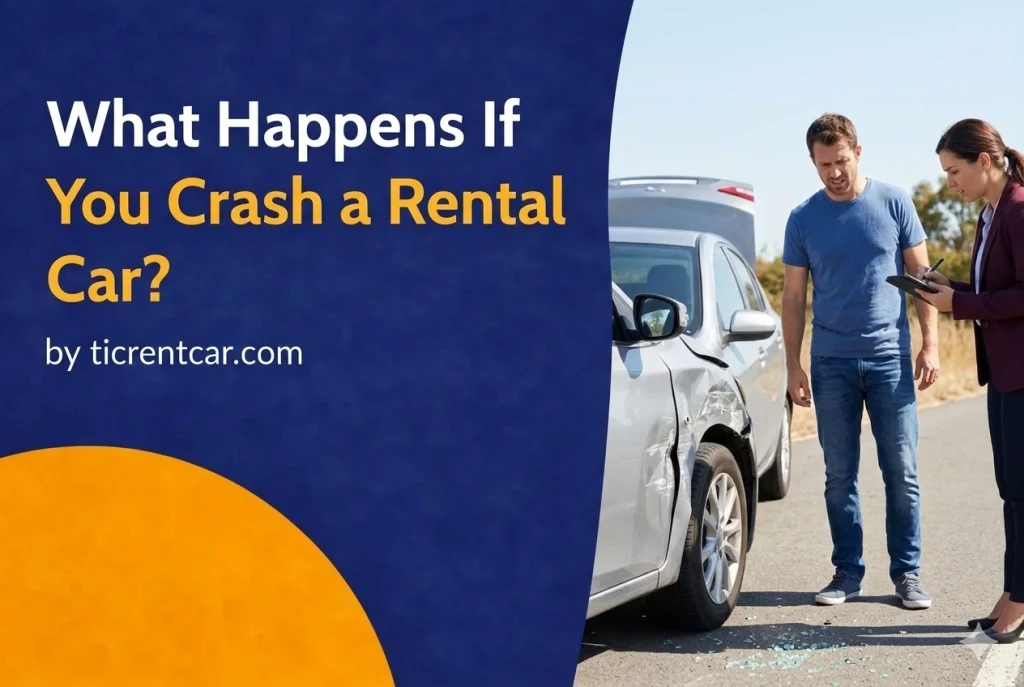
Nobody plans to have an accident on holiday. But Albania's mountain switchbacks, narrow coastal roads, and the occasional herd of goats crossing the highway mean it is worth knowing what to do if something goes wrong.
The good news: accidents in rental cars are rare, the process in Albania is straightforward, and if you rent from us, we handle most of it for you. This guide covers exactly what happens step by step — from the moment of impact to getting back on the road.
Step 1: What to Do Immediately After an Accident in Albania
The first few minutes matter. Here is what to do, in order:
1. Check for injuries. Make sure everyone in your car and any other vehicles involved is okay. If anyone is hurt, call Albania's emergency number: 112 (this connects to police, ambulance, and fire — it works the same as 112 across Europe).
2. Move to safety if possible. If the car is drivable and you are blocking traffic, pull to the side of the road. On narrow Albanian mountain roads this is not always possible — turn on your hazard lights and stay inside the vehicle until it is safe to get out.
3. Call TIC Rent Car immediately: +355 69 341 6449. This is the most important step. Call us before anything else (after ensuring safety). We will tell you exactly what to do from that point — whether to wait for police, where to go, and how to handle the other driver. We are available 24/7 and we speak English and Albanian.
4. Do not move the vehicles until police arrive (if there is damage to another car or property). In Albania, police must document the scene for any accident involving another party or significant damage. We will coordinate this for you when you call us.
5. Document everything while you wait. Use your phone to take photos of:
- All damage to your car and any other vehicles
- The position of the cars on the road
- The road conditions (wet, gravel, narrow, potholes)
- Any road signs or markings nearby
- The other driver's license plate
If there are witnesses, ask for their phone number.
6. Do not admit fault. This is important anywhere in the world, but especially in Albania where accident claims can be disputed. Do not apologize, do not sign anything the other driver gives you, and do not agree to pay cash on the spot. Let the police and insurance handle it.
Step 2: How Police Handle Rental Car Accidents in Albania
Albanian police will come to the scene for any accident involving another vehicle, injury, or significant property damage. Here is what to expect:
They will document the scene — measuring positions, taking photos, and interviewing both drivers. This is standard procedure and usually takes 30–60 minutes.
They will write an official accident report (procesverbal). This document is critical — it determines fault and is required for any insurance claim. Make sure your version of events is recorded accurately. If you do not speak Albanian, call us and we will translate over the phone or send someone to help.
They may ask for your documents. Have these ready: your driving license, your passport, and the rental agreement (there is a copy in the glove compartment). If you have an International Driving Permit, bring that too. For more on what documents you need, see our guide on whether visitors can drive in Albania.
For minor damage with no other party involved — such as scraping a wall in a narrow village street, bumping a post in a parking lot, or hitting a pothole — you may not need police. Call us first and we will advise you whether a police report is necessary.
Step 3: Understanding Insurance — What Is Covered and What Is Not
Every TIC Rent Car rental includes basic Collision Damage Waiver (CDW) at no extra cost. This covers damage to the rental car itself, with an excess (deductible) that you would be responsible for if the damage is your fault.
For complete peace of mind, we offer a full coverage upgrade that reduces or eliminates the excess entirely. Here is how they compare:
Basic CDW (included in every rental):
- Covers damage to the rental car from collisions
- Covers theft of the vehicle
- You pay the excess (deductible) if the accident is your fault
- Does NOT cover damage to tires, undercarriage, windshield, or interior
- Does NOT cover damage caused while breaking traffic laws (drink driving, unauthorized drivers, etc.)
Full coverage upgrade:
- Everything in basic CDW
- Reduced or zero excess — you pay nothing or a minimal amount regardless of fault
- Covers tires, windshield, and undercarriage
- The upgrade cost depends on the vehicle and rental duration — ask when you book
Our recommendation: If you are driving the Albanian Riviera (narrow SH8 with sharp turns), heading to Theth (mountain roads), or visiting in winter, the full coverage upgrade is worth it. For city driving and motorway-only trips, basic CDW is usually sufficient.
One more thing: Unlike most international agencies, we do not require a deposit. There is no €500–1,500 credit card hold blocking your funds while you travel. We also accept debit cards and cash — you can even rent without a credit card entirely.
For more on the general case for getting proper insurance, see our guide to whether renting a car in Albania is worth it — the insurance section covers this in detail.
Step 4: What TIC Rent Car Does After an Accident
This is where renting from a local company makes a real difference. Here is our actual process:
1. We handle the police and paperwork. When you call us, we coordinate with the police, help with translation if needed, and make sure the accident report is filed correctly. You do not need to navigate Albanian bureaucracy on your own.
2. We bring you a replacement car. If your rental is not drivable, we will arrange a replacement vehicle and get it to you as quickly as possible — usually the same day, depending on your location.
3. We handle the insurance claim. You do not deal with insurance companies directly. We process the claim, manage the repair, and communicate with you about any excess payment if applicable.
4. We do not charge hidden fees. We do not bill for "loss of use," "diminished value," or inflated administrative charges — practices that are common with international rental agencies. If you have basic CDW, you pay the excess and nothing more. If you have full coverage, you pay nothing.
5. You get back on the road. The whole point is to minimize disruption to your trip. An accident does not have to ruin your holiday.
Before You Even Drive Off: Inspect the Car and Take Video
This is the single most important tip from every traveler who has rented in Albania — and the one thing that prevents the most common disputes.
Before you leave our office or the airport, walk around the car and record a video of the entire exterior — all four sides, the roof, every panel, every existing scratch, dent, and scuff. Take close-ups of any existing damage. Open the doors and film the interior too. Make sure the video shows the date and time (your phone does this automatically).
Why this matters: when you return the car, the return agent inspects it and compares it to the pre-rental condition report. If there is a new scratch or dent, you are responsible for it. But scratches are easy to miss on a busy day. If you have a video showing the damage was already there, you have proof — and that video is worth more than any argument.
Our checklist before you drive off:
- Walk-around video of all exterior panels, bumpers, wheels, and roof
- Close-up photos of any pre-existing scratches, dents, or chips
- Check that all existing damage is noted on the rental agreement
- Photograph the mileage and fuel level on the dashboard
- Save everything in a dedicated phone folder — do not delete until after you return the car and get confirmation that everything is clear
This takes five minutes. It can save you hundreds of euros and a lot of stress. We document our cars thoroughly before every rental, but your own evidence is your best protection — with any rental company, anywhere in the world.
The Most Common Types of Rental Car Damage in Albania
Based on our experience, these are the accidents and damage types we see most often — and how to avoid them:
Scrapes on narrow village streets. The old towns in places like Gjirokastra, Berat, and the Riviera villages have very narrow stone streets. If you are driving an SUV, fold in your mirrors and take it slow. Better yet, park outside the old town and walk in.
Undercarriage damage on unpaved beach access roads. Some of the best beaches (like Gjipe and Pulëbardha) are accessed via rough gravel roads. A standard car can handle most of these, but driving too fast over rocks and ruts will scrape the bottom. Go slow, and if the road looks too rough, park higher up and walk.
Hitting livestock on rural roads. Goats, sheep, and cows regularly cross roads — especially in the mountains and on the SH8 between Himara and Saranda. This is most common at dawn and dusk. See our driving tips for Albania for more on this.
Parking damage in Tirana and Ksamil. Parking spaces are tight and other drivers can be careless with their doors. Use our Tirana parking guide to find safer lots, and in Ksamil, park on the main road and walk down to the beach rather than squeezing into the village streets.
Llogara Pass incidents. Sharp switchbacks, no guardrails in places, and tour buses taking wide turns. This is the most common stretch where tourists feel uncomfortable. Consider using the Llogara Tunnel if you are not confident on mountain roads, and choose an automatic car to keep both hands on the wheel.
What About the Other Driver's Insurance?
If the accident was not your fault, the other driver's insurance should cover the damage. In Albania, all vehicles are required to carry third-party liability insurance (called "TPL" or "sigurimi i mjetit").
In practice, the police report determines fault. If the other driver is found responsible, their insurance company pays for repairs to our car. You would not owe any excess in this case.
If the other driver is uninsured (rare but possible), our insurance still covers the damage to the rental car under your CDW. You would pay the excess unless you have full coverage.
Either way — you call us, and we handle the claim. You do not need to contact the other driver's insurance company yourself.
How to Avoid Accidents in the First Place
Most rental car damage in Albania is preventable. A few simple habits make a big difference:
- Do not drive at night on mountain roads. Poor lighting, no road markings, and livestock make this risky. Plan your drives so you arrive before dark.
- Choose the right car for your route. Driving the Riviera or visiting mountain villages? An SUV or automatic gives you more margin for error. Sticking to cities and motorways? An economy car is fine — see our cheap car rental options.
- Do not trust GPS shortcuts. Google Maps will sometimes route you onto unpaved mountain tracks. Stick to main roads (marked yellow or white on the map).
- Drive defensively. Albanian drivers can be aggressive — overtaking on blind corners is common. Let them pass, stay in your lane, and keep a safe following distance.
- Read our Albania driving guide before you go. We have covered road conditions, speed limits, and police checkpoints in a separate post.
Key Takeaways
- If you crash a rental car in Albania, call TIC Rent Car immediately at +355 69 341 6449 — we handle police, paperwork, insurance claims, and replacement vehicles.
- Every rental includes basic CDW at no extra cost. Full coverage is available as an upgrade for complete peace of mind.
- We do not require a deposit and we do not charge loss-of-use fees, diminished value, or hidden administrative costs.
- Before you drive off, take a walk-around video of the car — this is your best protection against return disputes.
- Albanian police will come to the scene for any accident involving another vehicle or significant damage. The official report determines fault.
- The most common damage comes from narrow streets, unpaved beach roads, and livestock — all avoidable with cautious driving.