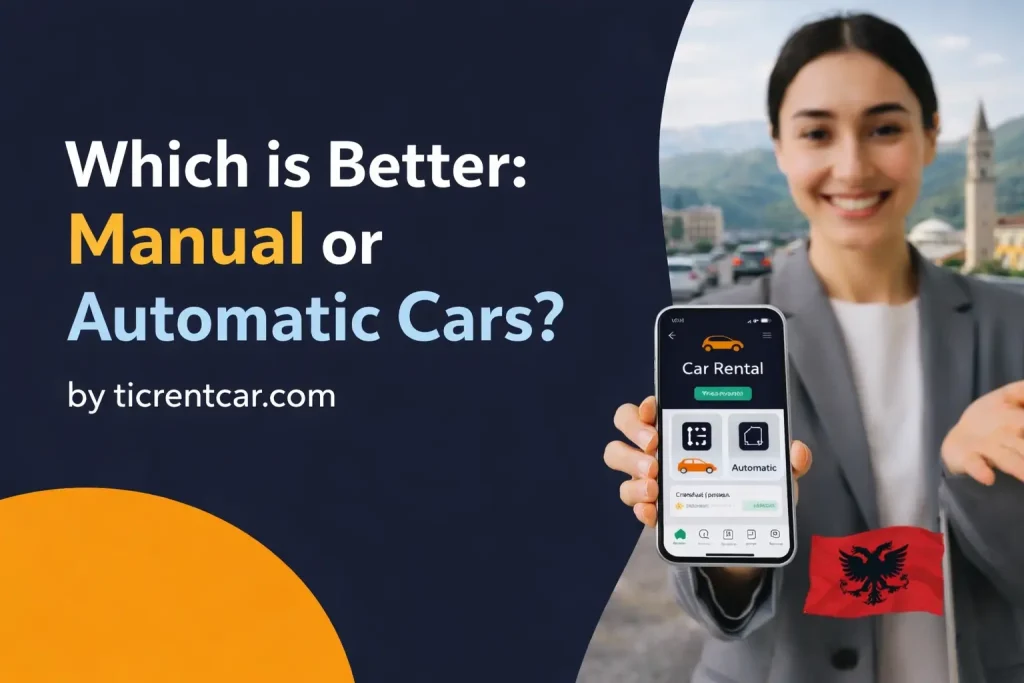
TL;DR: Most rental cars in Albania are manual, but for tourists dealing with Tirana traffic and unfamiliar mountain roads, automatic is usually the better choice. The price difference is smaller than you think, and modern hybrids have eliminated the old fuel-efficiency argument.
This question is often treated as a matter of taste, but for tourists in Albania, it’s a practical decision with real consequences. Most articles online reduce it to fuel consumption and price. That approach is shallow and outdated. To give a useful answer, you have to look at where you’ll drive, how long you’ll drive, and what kind of experience you want, not just the gearbox.
This analysis is based on 10 years of driving experience, roughly 30,000 km per year, mostly in Albanian cities, villages, and tourist routes, combined with long-term exposure to real rental decisions.
For many visitors, the real decision starts even earlier — whether renting a car in Albania is worth it in the first place, especially when traffic, road conditions, and driving comfort are taken into account.
Driving in Albania: the missing context
Albanian roads demand attention. In cities like Tirana, traffic is frequent, unpredictable, and often stressful for visitors. Outside cities, roads narrow quickly, signage can be inconsistent, and driving styles are more aggressive than many tourists are used to.
This matters because a transmission choice that feels trivial at home becomes important when:
- You are navigating unfamiliar roads
- You are driving in heavy traffic
- You are managing stress, navigation, and timing at the same time
Ignoring this context leads to bad advice.
Manual Transmission
The traditional choice
Lower Rental Cost
Manuals are generally cheaper to rent, though the price gap is narrowing.
High Cognitive Demand
Constant clutch use in Tirana traffic leads to rapid driver fatigue.
Engine Braking Control
Better control on steep descents — useful only for experienced manual drivers.
Automatic & Hybrid
The modern advantage
Reduced Stress and Fatigue
Focus stays on navigation and traffic rather than gear management.
Hybrid Fuel Efficiency
Modern hybrids often consume less fuel than manuals in city and coastal driving.
Enhanced Safety Focus
Lower mental workload allows faster reactions to unpredictable road conditions.
Rental Price
Slightly lower
Moderate
City Driving
Physically tiring
Effortless
Fuel Economy
Good (open roads)
Superior (city/traffic)
Manual cars: efficient by design, demanding in practice
Manual cars have traditionally been associated with lower fuel consumption and cheaper rental prices. In older petrol and diesel vehicles, this is often true, especially on open roads where gear control allows efficient driving.
However, this efficiency comes at the cost of continuous involvement. In traffic-heavy environments, a manual car requires constant clutch use, frequent gear changes, and sustained concentration just to move smoothly. For experienced local drivers, this becomes automatic. For tourists, it often turns into fatigue within the first few hours.
Manual driving also allows better use of engine braking, which can reduce brake wear and give more control on steep descents. This advantage is real, but only for drivers who already know how to apply it correctly. For most tourists, it offers little practical benefit during a short-term rental.
In short, manual cars reward skill, but they also punish inattention and tiredness.
Automatic cars: reducing cognitive load
Automatic cars remove a major source of stress: gear management. With only acceleration and braking to focus on, drivers can dedicate more attention to traffic behavior, pedestrians, navigation, and road conditions.
In Albanian cities, where stop-and-go driving is common, this reduction in mental workload is significant. Many tourists underestimate how tiring traffic can be, not because it’s especially dangerous, but because it demands constant reaction.
Older automatic transmissions did have a clear downside: higher fuel consumption, especially in traffic. That reputation persists, but it no longer tells the full story.
How hybrid technology changed the comparison
Modern hybrid vehicles fundamentally alter the manual vs automatic debate.
Hybrid cars:
- Recharge their batteries while driving
- Use electric power during low-speed city driving
- Rely on fuel mainly when higher power is required, such as steep climbs or hard acceleration
For typical tourist driving, city traffic, coastal roads, moderate speeds, hybrids often consume less fuel than older manual cars. This means that the traditional assumption “manual equals fuel savings” is no longer reliable.
Any article that ignores hybrids is already outdated.
Fuel, braking, and real-world traffic behavior
Manual drivers often rely on engine braking, while automatic drivers use the brake pedal more frequently. In theory, this can lead to more brake use in automatics. In practice, for short-term rentals:
- Brake overheating is extremely rare
- Modern braking systems are designed for frequent use
- The difference is negligible compared to the impact of driver fatigue
What matters far more is how comfortable and alert the driver remains over time. Stress and fatigue increase the risk of mistakes much more than brake usage ever will.
A real rental decision in practice
A friend visiting from Germany needed to rent a car for a trip that included driving through Tirana and traveling south toward Vlorë. After discussing traffic conditions and driving comfort, he chose an automatic car.
The outcome was straightforward: less stress in traffic, easier navigation, and more focus on the journey itself. This is a common pattern, not an exception.
The pricing myth: manual vs automatic
It is true that manual cars are usually cheaper. What is misleading is the scale of that difference.
In short-term rentals, especially in the mid-range category, the price gap between manual and automatic cars is often modest. When weighed against comfort, energy, and overall enjoyment of the trip, the savings from choosing a manual car are frequently overestimated.
While manual cars are usually slightly cheaper, the difference is often smaller than people expect, especially if you know how to find a cheap car rental in Albania without sacrificing comfort or reliability.
So which is better?
There is no absolute answer, but there is a contextual one.
For tourists visiting Albania, driving in cities, dealing with traffic, and navigating unfamiliar roads, automatic cars are usually the better choice. They reduce stress, lower fatigue, and allow drivers to focus on the experience rather than the mechanics of driving.
Manual cars remain a valid option for drivers who:
- Are highly experienced with manuals
- Intentionally seek lower rental costs
- Plan to drive mostly outside urban traffic
Choosing a manual car out of habit or outdated advice, however, often leads to regret.
Final conclusion
The manual vs automatic debate is not about which transmission is “better” in theory. It’s about which one fits your situation.
Transmission type isn’t the only practical concern for travelers — many visitors are also surprised to learn that it’s possible to rent a car without a credit card, depending on the rental company and conditions.
For most tourists in Albania, especially in today’s traffic conditions and with modern hybrid options available, automatic cars provide a calmer, more enjoyable driving experience. And on a trip, that advantage outweighs small cost or fuel differences.
After years of observing real rental behavior and real driving outcomes, the pattern is consistent: comfort wins.